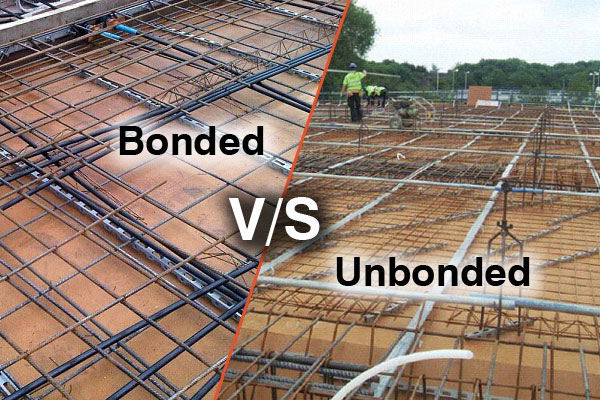
Difference Between Unbonded and bonded Post-Tensioning System
This is a critical distinction for post-tensioning (PT) design and construction—bonded PT relies on grout to bond tendons permanently to concrete, while unbonded PT uses greased tendons in plastic sheathing to keep tendons isolated from concrete. Below is a comprehensive breakdown of their differences, organized by core definition, components, installation, performance, applications, and pros/cons.
Core Definitions
Bonded Post-Tensioning System: High-strength strands/cables are placed inside steel or plastic ducts within the concrete. After tensioning and anchoring, the duct is fully pressure-grouted with cementitious grout. The grout bonds the tendon to the concrete, making the tendon and concrete act as a single composite structural element.
Unbonded Post-Tensioning System: Tendons are pre-greased (corrosion protection) and encased in an extruded plastic sheathing (HDPE/PP) at the factory. No grouting is done after tensioning. The tendon can move relative to the concrete (limited by anchors and end fittings), acting as a direct tension element that applies precompression via the anchors alone.
Structural Performance & Behavior Differences
Force Transfer Mechanism:
Bonded PT: Tendon force transfers to concrete via grout-concrete and grout-tendon bond along the entire tendon length, plus anchor force transfer. Precompression distribution is gradual along the span.
Unbonded PT: Tendon force transfers only at the anchors (no bond along the tendon). Precompression is applied as concentrated forces at the anchor zones, with a linear precompression gradient along the span.Crack Control & Ductility:Bonded PT:
Better crack control at service loads; tendons are locked to concrete, so cracks propagate slower. Higher ductility under ultimate loads (tendon yields and bonds resist failure).Unbonded PT: Tendons can slip relative to concrete; cracks may open more easily under overload. Lower ductility (failure is more brittle if anchors slip or tendons rupture).Creep & Shrinkage Effects:Bonded PT: Tendons are constrained by concrete, so creep and shrinkage cause loss of prestress force (tendon shortens with concrete).Unbonded PT: Tendons are free to move, so creep and shrinkage cause larger prestress losses (concrete shortens independently, and tendon tension reduces more) unless compensated by over-tensioning.Fatigue Resistance:Bonded PT: Higher fatigue resistance—bond distributes cyclic loads along the tendon, reducing stress concentrations at anchors.Unbonded PT: Lower fatigue resistance—all cyclic loads are concentrated at the anchors and wedge interfaces.
Typical Applications
Bonded PT: Long-span bridges, heavy industrial buildings, parking garages with high fatigue loads, precast concrete girders, and structures in aggressive environments (coastal areas—grout provides extra corrosion protection).
Unbonded PT: Residential slabs, commercial floor slabs, thin-walled structures, precast panels, and projects where fast construction is a priority (no grouting=shorter schedule).
Send Inquiry



X
We use cookies to offer you a better browsing experience, analyze site traffic and personalize content. By using this site, you agree to our use of cookies.
Privacy Policy