How Does an Expansion Shell Rock Bolt Improve Rock Anchoring?
An expansion shell rock bolt creates a mechanical anchoring point by expanding against the surrounding rock or concrete. In this article, we explain how M16 Expansion Shell Rock Bolts work, why forged carbon steel shells and cast iron anchor bolts are used, and how manufacturing, machining, and quality inspection affect product consistency. Drawing on our more than 25 years of metal casting experience, Supreme Machinery also shares practical considerations for selecting and manufacturing rock anchoring components.
Table of Contents
- How Does an Expansion Shell Rock Bolt Work?
- Key Components and Material Selection
- How We Manufacture Expansion Shell Rock Bolts
- Factors Affecting Rock Anchoring Performance
- Typical Applications of M16 Rock Anchor Bolts
- Quality Control and Inspection
- Frequently Asked Questions
How Does an Expansion Shell Rock Bolt Work?
An expansion shell rock bolt improves rock anchoring by creating mechanical contact between the anchor assembly and the surrounding rock. Instead of relying entirely on adhesive bonding, this system uses an expanding shell to grip the inside surface of a drilled hole.
In a typical installation, the expansion shell is positioned inside the drilled hole, and the rock anchor bolt is inserted through the assembly. As the bolt is tightened according to the installation design, the shell expands outward and presses against the hole wall. This mechanical engagement creates a fixed anchoring point.
We consider the contact between the expansion shell and the surrounding material particularly important. If the hole diameter, shell dimensions, or installation conditions are unsuitable, the shell may not develop consistent contact. This is why component dimensions and compatibility should be checked before installation.
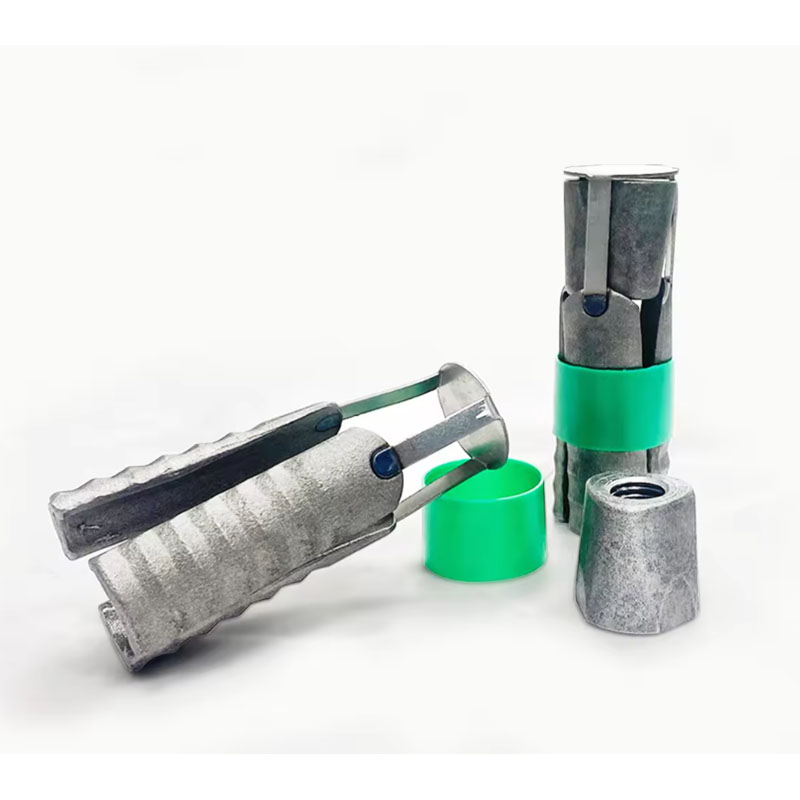
Our M16 Expansion Shell Rock Bolts are designed for rock anchoring applications in sound rock or concrete. They can also be used in applications involving one-sided wall forming, where access to the opposite side of the structure is limited.
Key Components and Material Selection for M16 Expansion Shell Rock Bolts
Material selection affects the manufacturing process, dimensional consistency, and suitability of each component. For our expansion shell rock bolt assembly, we use different materials and production methods for the shell and anchor bolt rather than treating them as identical parts.
| Product Parameter | Specification |
|---|---|
| Product Name | M16 Expansion Shell Rock Bolts |
| Product Type | Expansion Shell Rock Anchor Assembly |
| Expansion Shell Material | Carbon Steel |
| Rock Anchor Bolt Material | Cast Iron |
| Expansion Shell Manufacturing Process | Forging |
| Rock Anchor Bolt Manufacturing Process | Casting |
| Surface Finish | Oil Rusty Finish |
| Application | Rock and Concrete Anchoring |
Why Use Forged Carbon Steel for the Expansion Shell?
The expansion shell needs to maintain its shape and interact properly with the drilled hole during installation. We use carbon steel for this component and manufacture it through forging.
Forging shapes the metal through controlled pressure, making it suitable for producing components with defined geometries. For expansion shell anchors, the manufacturing focus is on forming consistency, dimensional accuracy, and the fit between mating components.
We pay particular attention to the shell's dimensions and contact surfaces because even small differences can affect assembly compatibility and the way the shell engages with the surrounding material.
Why Use Cast Iron for Rock Anchor Bolts?
Our rock anchor bolts are produced from cast iron. Casting allows the metal to take the required component shape through a mold-based manufacturing process.
As a metal foundry with more than 25 years of production experience, we understand the importance of controlling casting quality before components move to subsequent machining operations. Casting quality, dimensional consistency, and machining requirements all need to be considered together.
How We Manufacture Expansion Shell Rock Bolts
At Supreme Machinery, we combine forging, casting, and machining capabilities to manufacture different metal components. The M16 expansion shell rock bolt assembly involves separate production routes for its two main components.
1. Expansion Shell Forging
We manufacture the carbon steel expansion shell through forging. During this stage, the metal is shaped to achieve the required component geometry. Process control is important because the shell must fit correctly with the corresponding anchor bolt and perform its intended expansion function.
2. Rock Anchor Bolt Casting
The cast iron rock anchor bolt is produced through casting. Molten metal is poured into a prepared mold and allowed to solidify into the required shape. After casting, the components are prepared for further processing.
Our foundry experience includes gray iron casting, ductile iron casting, and precision investment casting. These capabilities support our production of metal components for construction machinery, mining equipment, hydraulic systems, and other industrial applications.
3. CNC Machining and Dimensional Processing
After the initial forming or casting stages, machining is used where required to achieve the specified dimensions and assembly interfaces.
Our machining workshop is equipped with CNC equipment and machining centers. We use these facilities to process components according to customer drawings and technical requirements. For rock anchor assemblies, the important considerations include dimensional consistency, mating-part compatibility, and the accuracy of specified machined surfaces.
4. Inspection and Packaging
After machining and inspection, qualified components are prepared for packing and shipment. We can customize packaging for M16 Expansion Shell Rock Bolts according to transportation and customer requirements.
Available packaging options include plastic bags, cartons, wooden cases, and crates. The final packaging method can be selected according to order quantity, product dimensions, and shipping arrangements.
Factors Affecting Rock Anchoring Performance
A rock anchor bolt assembly does not work independently of its installation environment. In our experience, evaluating the complete anchoring system is more useful than looking at the bolt material or nominal size alone.
| Factor | Why It Matters | What to Check |
|---|---|---|
| Drilled Hole Diameter | Determines whether the expansion shell can engage properly with the hole wall. | Confirm compatibility with the specified shell dimensions. |
| Rock or Concrete Condition | Material strength and surface condition influence mechanical anchorage. | Check whether the installation substrate is suitable for expansion anchoring. |
| Expansion Shell Geometry | Affects contact with the drilled hole and assembly compatibility. | Verify shell dimensions and forming consistency. |
| Bolt and Shell Compatibility | Both components must work together during installation. | Check mating dimensions and assembly requirements. |
| Installation Procedure | Incorrect installation may prevent the anchor from developing the intended engagement. | Follow the specified installation and tightening procedure. |
| Surface Condition | Surface finish influences storage and handling conditions. | Confirm finish requirements and protection during transportation. |
One point we would emphasize is that an M16 designation alone does not establish the allowable anchoring load. Actual load capacity depends on the complete assembly design, drilled hole dimensions, substrate conditions, and installation method. For structural or underground support projects, these parameters should be verified through engineering calculations and appropriate testing.
Typical Applications of M16 Expansion Shell Rock Bolts
Expansion shell anchors are used where mechanical anchoring into sound rock or concrete is required. The M16 expansion shell rock bolt assembly is suitable for projects that specify this type of anchoring arrangement.
- Rock Anchoring: Used to establish mechanical anchoring points in suitable sound rock formations.
- Mining Projects: Can be incorporated into mining-related anchoring systems where the project design specifies expansion shell components.
- Concrete Structures: Used for anchoring applications in suitable concrete substrates.
- One-Sided Wall Forming: Rock anchors can support wall-forming arrangements where installation access is available from only one side, subject to the project design.
- Construction Engineering: Applied in construction projects requiring mechanical anchorage into rock or concrete.
For mining and construction applications, we recommend confirming the substrate condition, required anchoring depth, installation space, and design load before selecting the final product configuration.
How We Control the Quality of Rock Anchor Components
At Supreme Machinery, quality inspection is integrated into different stages of production rather than being limited to a final check before shipment. Our inspection process covers incoming materials, production operations, finished components, and outgoing products.
Incoming Quality Control
We check incoming raw materials after they arrive at our factory. Material condition and relevant requirements are reviewed before production begins.
In-Process Quality Control
We inspect important production details before operating the production line. During mass production, we conduct full inspections and routing inspections to identify potential dimensional or processing issues.
Final and Outgoing Quality Control
Finished goods are checked after production. Before shipment, outgoing inspections provide another opportunity to verify product condition, quantity, and packaging requirements.
Our goal is to reduce inconsistencies between production batches and ensure that the supplied components meet the agreed technical specifications.
Why Work with Supreme Machinery?
Supreme Machinery is Ningbo Supreme Machinery Co., Ltd., a professional metal foundry in China with more than 25 years of experience in metal casting.
Our production experience covers gray iron casting, ductile iron casting, and precision investment casting. We serve customers in industries including agricultural machinery, construction machinery, mining, hydraulics, automotive components, and industrial equipment.
For expansion shell rock bolts and related metal components, our manufacturing capabilities offer several practical advantages:
- More than 25 Years of Foundry Experience: Extensive experience in manufacturing iron castings and industrial metal components.
- Multiple Manufacturing Processes: Casting, forging-related component production, and machining capabilities support different product requirements.
- CNC Machining Facilities: CNC equipment and machining centers support dimensional processing based on technical drawings.
- Application-Oriented Production: Experience in mining and construction machinery components helps us understand industrial manufacturing requirements.
- Quality Inspection: Incoming, in-process, final, and outgoing quality checks are incorporated into our production workflow.
We focus on manufacturing consistency and technical requirements rather than assuming that one component specification fits every project. Customers can provide drawings, samples, or product specifications for technical evaluation before production.
Frequently Asked Questions About M16 Expansion Shell Rock Bolts
1. What is an M16 expansion shell rock bolt?
An M16 expansion shell rock bolt is a mechanical anchoring assembly designed to secure components within suitable drilled holes in rock or concrete. Its expansion shell expands against the hole wall to establish mechanical engagement.
2. What materials are used in M16 Expansion Shell Rock Bolts?
In our product configuration, the expansion shell is made from carbon steel, while the rock anchor bolt is made from cast iron. The shell is manufactured through forging, and the anchor bolt is manufactured through casting.
3. What is the difference between a forged expansion shell and a cast anchor bolt?
A forged expansion shell is shaped through metal deformation under pressure, while a cast anchor bolt is formed by pouring molten metal into a mold. These processes are selected according to the different component geometries and manufacturing requirements.
4. Can expansion shell rock bolts be used in concrete?
Yes. Expansion shell rock bolts can be used in suitable concrete anchoring applications. However, the concrete condition, hole dimensions, anchor configuration, and required load capacity must be evaluated before installation.
5. What surface finish is available for these rock anchor bolts?
The listed M16 Expansion Shell Rock Bolts feature an oil rusty finish. Other surface treatment requirements should be confirmed with the manufacturer before production.
6. How do I select the correct expansion shell rock bolt?
Start with the required bolt size, drilled hole diameter, anchoring depth, substrate condition, and design load. You should also confirm the shell dimensions and installation procedure to ensure that the complete assembly is compatible with the project.
7. Does Supreme Machinery provide customized rock anchor components?
Yes. We can evaluate customer drawings, samples, and technical specifications for metal component manufacturing. Our casting and machining capabilities support different industrial component requirements. Customized production details should be confirmed according to the specific project.
8. How are M16 Expansion Shell Rock Bolts packaged for shipment?
Packaging can be customized according to customer requirements. Common options include plastic bags, carton boxes, wooden cases, and crates, depending on product quantity, dimensions, and transportation conditions.
Conclusion
An expansion shell rock bolt improves mechanical anchoring by expanding against the surrounding rock or concrete and establishing a secure contact point. Its performance depends on more than the nominal M16 size. Component materials, shell geometry, casting and forging quality, machining accuracy, and installation conditions all play important roles.
At Supreme Machinery, we combine more than 25 years of metal foundry experience with machining and quality inspection capabilities to manufacture industrial metal components. Whether you need M16 Expansion Shell Rock Bolts or customized cast iron components for mining and construction applications, we welcome technical drawings and product specifications for evaluation.
To learn more about our manufacturing capabilities and product range, visit Supreme Machinery or explore our industrial metal casting products.
Send Inquiry



X
We use cookies to offer you a better browsing experience, analyze site traffic and personalize content. By using this site, you agree to our use of cookies.
Privacy Policy